Californianismo
Staring into the abyss of the current American identity.

"The Spanish government will not applaud those who set the world on fire just because they turn up with a bucket." — Spanish Prime Minister Pedro Sánchez, April 2026
It’s taken eight years of living part-time in Europe for my American identity to boil to the surface. For so long I’ve blended fairly seamlessly into Spanish life. Many people mistake me for being French but it’s my northern California can do energy that propels me, the belief that we’re here to show up and work hard, create and protect beauty, eat (and drink) well, respect each other, make a difference in the world at least within our circle of friends, whenever possible. When asked where I’m from, I always say California, which is obviously only half the story.
My Spanish friends have always been sympathetic to the cess pool that US politics has become over the last decade and didn’t even hold it against me that we were beginning to drag the rest of the world down with us. The Spaniards follow US politics almost as closely as Americans do and realize that only a smidge more than half of the electorate voted for Trump the second time. It’s the second time that most people can’t fathom. Europe—and the Spanish—have been dealing with their own far right extremism for some time too. And it didn’t even seem to matter that I was part of a wave of Americans (Ukrainians, Russians, Argentines and Dutch) moving to Valencia and driving up the cost of living and housing. At least I spoke the language and was trying to assimilate.

But when I arrived in February 2026 there were cracks in that foundation. So many Spaniards were asking me, “what is up with the United States and Venezuela?” We were no longer just turning our backs on friends and neighbors in Europe and Ukraine. Venezuela seemed like a line too far.
Then came Greenland. And Cuba. And before I left just five weeks later, Iran. I remember standing on a street corner of the Plaza de España. My American-ness, which I had been shielding with Californianismo, hit me like a ton of bricks. My fancy sneakers, my personal daily ambition to accomplish the super human, my default assumption that—to quote a great American songwriter—most things can be solved with lawyers, guns and money.
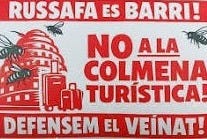
Case in point. I have a dear friend who is an attorney and we share a common predicament. We both own apartments on the same city block that is squared off by three other city blocks of mostly apartment buildings. The interior of that square of buildings is called a patio de manzana. An Israeli real estate conglomerate is trying to in-fill that common patio space with a hotel and parking garage that would create a building density that is unheard of in the city. Hundreds of potentially impacted apartment owners fear fire danger, lack of privacy, lack of sunlight and ventilation, failing psychological health, etc. All rightly founded. They are protesting the government license that would favor foreign touristic development over residential community well being.
I tell my friend we just need a great legal team with lots of money and we should buy out this project and make the common area a park that everyone can enjoy. He looks at me like I’m from Mars—not California. There’s no way the community can buy out the foreigners who’ve already sunk millions into this game. The Spanish people are neither litigious nor deep pocketed. There is a legal permitting process through which both sides must navigate.
The community has rallied with protests, banners, press outreach, testimonies at hearings, eloquent arguments in defense of community. But business is business, and who knows who is really pulling the strings? The outcome of this project could have critical implications for the future of the city. I find myself looking in the mirror at my American privilege, even if I still relegate it to Californianismo.
Somehow some day I’d like to find a way to become a citizen of The World.
If you’re looking for a podcast, please try Full Expression.
All for now.