Utopian Boot Camp
The Bauhaus inspired Pond Farm school that launched a studio pottery movement.

“Pots are made out of clay but the hollow in them is the essence of the pot.”—Lao Zi
The Bauhaus school came on the scene in Germany as a reaction to epic cultural, economic and political upheaval in the aftermath of World War I. The impetus was for artists to return to their roots in craftsmanship, but at the same time to merge with the industrial economy, in order to create something entirely new. Spread across different areas of Germany, the Bauhaus became a magnet for all stripes of artists, including Lyonel Feininger, Paul Klee, Josef Albers, Vasily Kandinsky, and a Who’s Who of 20th century cultural creatives.
While existing for little more than a decade, it would become one of the 20th century’s defining artistic movements and, according to many, the beginning of modernism. The radiating lessons that Bauhaus participants produced had a massive and lasting influence on art, craft and design that still seems relevant today.
One of the first students to answer Walter Gropius’ call to enroll in the Bauhaus School was Marguerite Friedländer, a 20-year-old French born artisan interested in ceramics. For Marguerite, joining the Bauhaus meant living with a small cohort of fellow students commune style in Dornburg and helping build the facilities from scratch. She then served a rigorous apprenticeship with both a master potter, Max Krehan and master sculptor, Gerhard Marcks. Krehan was a stern mentor who assigned her to a kick wheel that had “1609” carved into its base. Combined with her 8 hour per day ceramics training, the exposure to an artistic community with clashing schools of thought made for a profound education.
After 7 years Marguerite became Germany’s first female master potter. (She married her apprentice, Franz Wildenhain, in 1930.) Soon she was making a name for herself with modern porcelain ceramic designs and a style all her own. The National Socialists rose to power and in 1933 they fled Germany because of her Jewish heritage.


Marguerite and Franz moved to the Netherlands where she restarted her career. It would be short-lived. The Germans invaded Holland in 1940 and like many artists in Europe during this chaotic time she escaped to the United States. Franz was conscripted into the German army.
After attempts to settle in New York and the eastern US, Marguerite moved to California. She soon accepted Jane and Gordon Herr’s invitation to join them in a new venture. The Herrs owned an old ranch outside of Guerneville and for many years had been recruiting exiled European Jewish artists, including veterans of the Bauhaus School, to practice and teach there. Their aim was to establish a Utopian artist community in the hills of West Sonoma County, perhaps inspired by the Black Mountain School in North Carolina.
Creating a school in a remote area with highly driven artistic personalities and no electricity or running water proved to be an extremely tall order. Like many utopian experiments, this one lasted only a handful of years. Franz eventually joined Marguerite in California after the war but their marriage was strained by time and distance, and no doubt, trauma. It ended before the school disbanded in 1953.
Despite the isolation and primitive nature of the site, Marguerite chose to stay on. The Pond Farm Pottery school she started became foundational for the studio arts movement of the 1960s, 70s and 80s. Her summer pottery bootcamps were legendary. Enrollment was extremely competitive. Students often returned year after year even though they could take home almost nothing they had made—8 hours per day for 9 weeks. The practice was the finished product.
“Pond Farmers,” as they became known, praised Marguerite’s ability to bring out the best in people, even while rarely showering them with praise. “A millimeter makes a difference,” was one of her oft used phrases. In the excellent PBS documentary film “From the Bauhaus to Pond Farm,” Marguerite says:
“It’s not the technique. I admire if you have something to say with that technique, you know. The prehistoric people had no technique to speak of. But they could make pots that move you.”
My brother John is an architect and incredibly artistically curious and led me to Pond Farm. We both studied ceramics in high school with an amazing teacher named Becky Simeral, who lit a creative spark in me and was a true life saver for so many students. Among many things, Becky taught me to appreciate the happy accident.
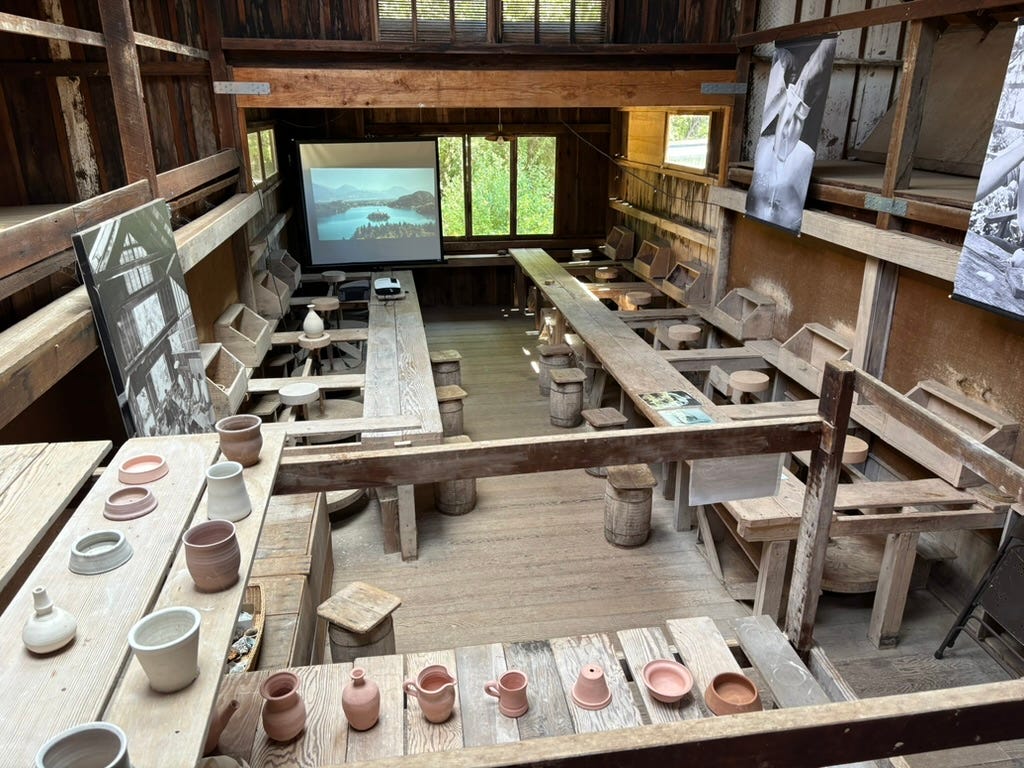
John and I drove through the redwoods on a Saturday morning to visit Pond Farm for a history lesson and kick wheel demonstration. As historian Leah Halper and Pond Farmer, James Dahl, explained to me, Marguerite’s mission was not to create potters—the world had enough potters—but rather well rounded people who led artistic lives. James went on to make more than 80,000 pots.
Pond Farm Pottery is now a state monument and national historic landmark located in the Armstrong Woods open every third Saturday by appointment.
Thanks for your subscriptions, reviews and comments.
From the Bauhaus Manifesto
Architects, Sculptors, Painters— we must all return to craftsmanship!
There is no essential difference between the artist and the artisan.
Let us strive for, conceive and create the new building of the future that will unite every discipline
as a clear belief of a new symbol to come. — Walter Gropius Founder, 1919
Please check out our latest episode on Full Expression: How The Bauhaus Found A Home In California.
All for now.